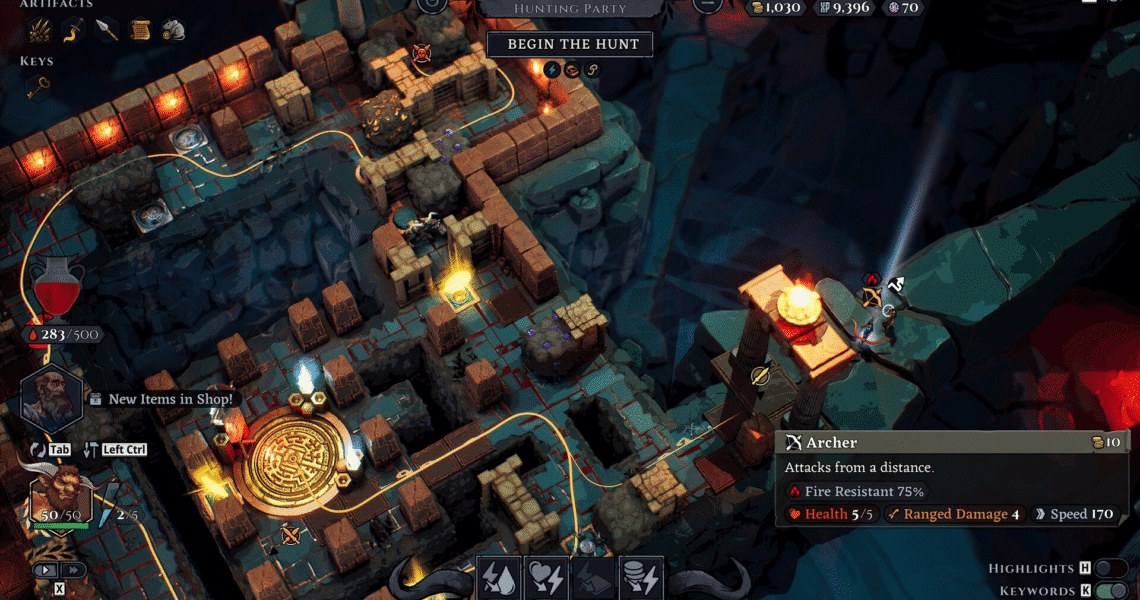
MINOS - a tower defense game for the nerd puzzle players
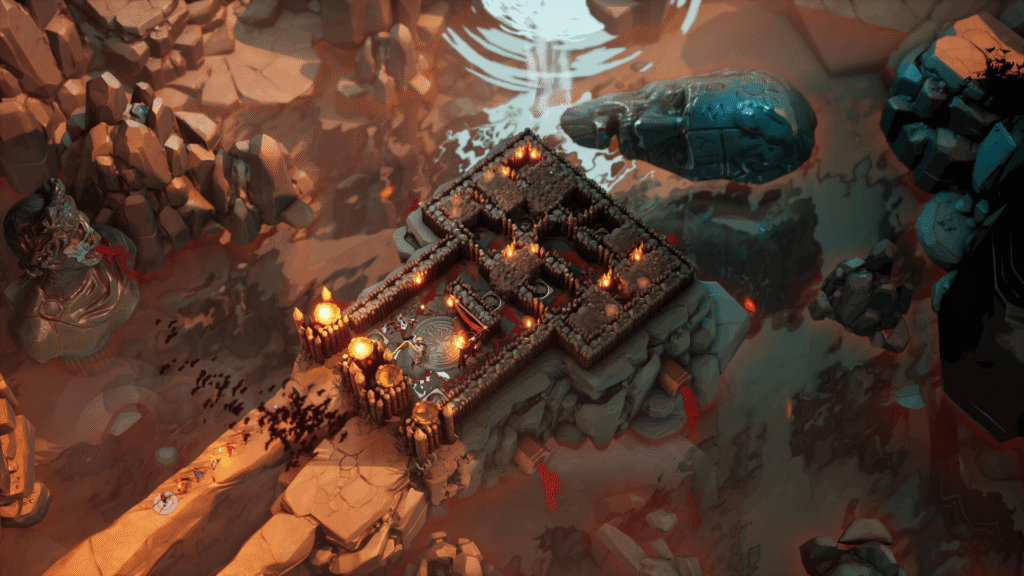
I've never been the big tower defense player. When I hear the genre, I think quickly at games like Bloons, where you place tower after tower and see thousands of enemies being shot down.
MINOS was therefore not a game I had the greatest expectations of when I first tried it during a Steam Next Fest demo. But already there was something different about it. It didn't feel like a typical Indian demo that was just supposed to show off its idea. MINOS felt like a finished game.
The graphics were worked out, the user interface was clean, the sound page worked, and even the settings in the menu gave the impression of a game that was much longer in its development than many other demos. And then Daedalus had a voice actor who immediately made a good impression.
But it wasn't until I started playing that I found out why MINOS caught me.
MINOS is not quite the tower defense game I expected
The Grundid is really simple.
You must protect the minotaur Asterion from waves of enemies trying to find their way into his lair. The enemies come in different places on the field, and you need to make sure they're killed before they get there.
You do that by building a maze.
You place traps on certain slots around the field. These can be spikes, ballistas, fire traps, catapults and a lot of other traps that you will eventually be able to access.
But you don't just decide where to shoot the enemies.
You're very much in charge, too. Where to go.
All entrances must have a way to Asterion's lair, which means that you quickly start thinking more about the route itself than about the individual traps.
Maybe you're building a long detour from one entrance to force the enemies through a series of traps. It works perfectly.
Until the next wave comes from another entrance.
All of a sudden, the enemies go a whole different way, and your otherwise brilliant plan isn't nearly as brilliant anymore.
This is where MINOS starts to feel more like a puzzle game than classic tower defense.
Most of the game takes place before you press start
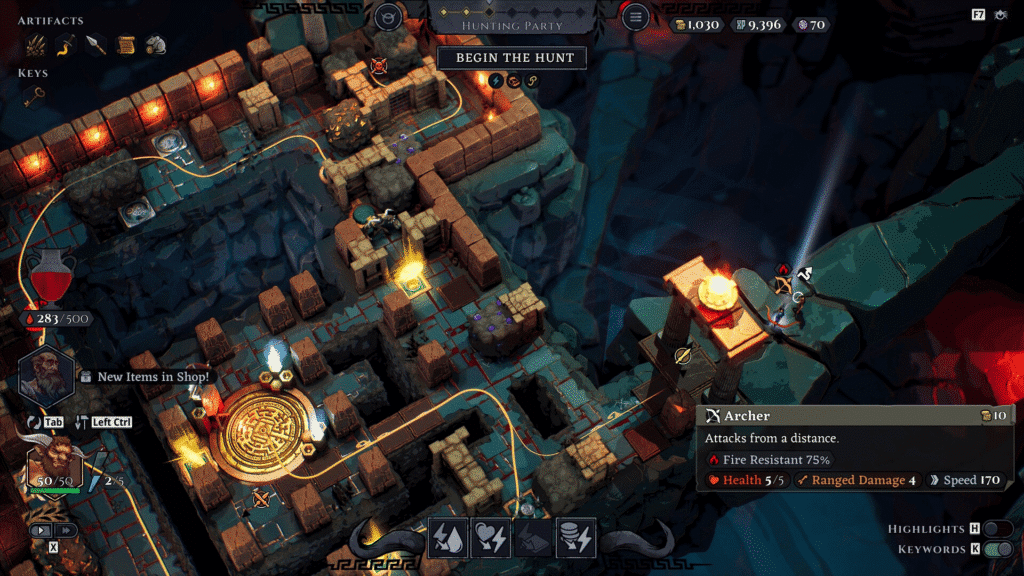
The most interesting thing about MINOS is actually not the fighting itself.
It's planning.
In the first Depths it is relatively simple. You have a large enough arsenal of traps for that there are often more solutions to the problem. But down below, it starts to feel like a puzzle game where there are suddenly far fewer real solutions.
You can sit and think:
If that wall is there, the enemy goes that way. If I put this trap here, it'll hit the back enemy in the group. But who's at the back when they get there? And if the trap does 6 damage, is that enough to kill the enemy, or am I wasting some of the damage?
It could be surprisingly nerdy.
At some point you can almost sit and figure out how to get exactly 20 damage out of your traps if the enemy has 20 HP.
And that's exactly what I think is funny.
I often spend much more time planning a track than I do watching my plan unfold. Kind of reminds me of Prison Architect that way. The interesting thing is to sit and build the solution and then see if it works.
When you press the start on the next wave, you often already know what should happen.
Until the game tells you you were wrong.
Enemies make the puzzle harder
Of course, it would be boring if all enemies just had different amounts of HP.
It starts relatively simple, but gradually there are enemies who force you to think in completely different ways.
Some enemies come in groups where suddenly it matters which enemy stands at the front or at the back. Others suffer less damage from specific attacks.
And then comes Evaders and Disarmers.
Evaders cannot step on traps in the same way as ordinary enemies. Disarmers are even worse. If they cross a trap, they'll deactivate it.
This means that a trap is not necessarily a trap anymore.
Suddenly, don't just think about how much damage you can do. You must also think about which enemies reach which traps and whether your traps are activated at all.
This is where MINOS really shows how much depth is hidden in the simple system.
The traps become part of your puzzle
One of the best things about the trap system is that they're not just different versions of the same weapon.
There are traps that can be combined.
For example, poison and fire can be used together in ways that create explosions. Later you will also get more specialized versions of known traps.
It can be a spike step that does more damage, but only hits the third enemy who steps on it.
Suddenly the question is no longer just:
"Where should I put my spike step?"
It will be:
"Who's gonna be number three when they get here?"
And that's a pretty good description of MINOS.
It's a game that keeps trying to make you think one step further forward.
Asterion is more than just the one you need to protect
Asterion is not just a figure standing in the back waiting to be rescued.
He has his own energy, which can be used to remove soil walls and later create more opportunities to place traps.
This means that you should also consider how to use his resources.
In addition, you can actually move Asterion when a wave starts. It opens up some tactical possibilities, but the vast majority of the work is still in planning.
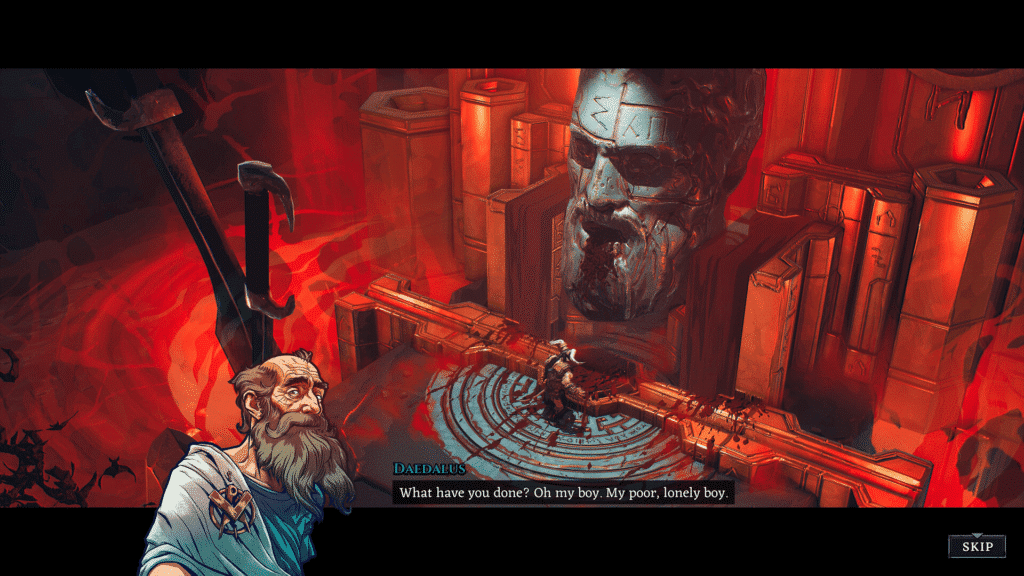
And then there's the relationship between Asterion and Daedalus.
The two have a story together, and the game spends time telling it. Daedalus speaks to Asterion after the tracks, and there's a bigger story behind their relationship and the world they're in.
The Greek mythology is clearly present, but MINOS is also trying to tell its own version of history.
It helps to make the game more than just a system where traps are placed.
The Roguelite part makes each play different
MINOS also uses a roguelite structure.
You move through various Depths, which can be thought of in practice as the game tracks. Depth 1, Depth 2, Depth 3 and so on.
The further down you get, the harder the enemies get, but you also get the opportunity to expand your arsenal.
Along the way, you can buy new traps from merchandise or unlock new options. You can also earn blood through your performance, for example by killing enemies and ensuring that Asterion is not harmed.
The problem is, that arsenal doesn't necessarily come with you forever.
When you die, you start again from Depth 1 and the traps you had locked up to that run are reset.
It can be frustrating.
Especially if you've just been deep down in the game and now have to go through the first tracks again, where you hardly have to think.
But it's also part of the game idea. You learn from what went wrong and try again with a new arsenal and new possibilities.
MINOS feels like chess
Actually, I think it's the best way to describe MINOS.
It feels like chess.
You're thinking about your next move. You think about how enemies move, what your traps can do and how the different elements can be combined.
And when you finally start a wave, you've often already played it inside your head.
Of course things can go wrong. Maybe an enemy doesn't die where you expected. Maybe two groups meet at an unfortunate time, so the enemy you thought would be hit suddenly stands behind someone else.
But most often you know too, What went wrong.
It's an important difference.
You don't necessarily die because your reflexes weren't good enough. You die because your solution wasn't good enough.
And then you'll want to try again.
A game for the nerdy puzzle players
I think you have to be a little nerdy to really get the maximum out of MINOS.
I myself am quite fond of such systems, but even I am still a long way from understanding how all traps are best used. I often end up sticking to the traps I know because I know how they work.
I'm sure there are combinations and solutions I haven't discovered yet.
And it's actually one of the biggest strengths of the game.
MINOS is not trying to make you a fast player. It's trying to make you a better problem solver.
That's why I find it hard to just call it a tower defense game.
Yes, you defend Asterion against waves of enemies.
But in practice, you sit down much more often and solve a puzzle than you sit and shoot down thousands of enemies.
MINOS is a new take on tower defense
For me, MINOS feels like a new take on tower defense.
It's slow, tactical and surprisingly deep. It is less about responding quickly and much more about understanding the problem in front of you and finding the best solution.
If you love strategy, tactics and puzzle games, I certainly think MINOS is worth looking at.
And if you don't usually want to be a tower defense, I'd actually still give it a chance.
Because MINOS doesn't feel like the tower defense game I would normally skip.
It feels like a puzzle game that happens to have decided to hide its puzzles inside a maze and send enemies through them.

